↓Skip to main content

Python Code for Lorenz Attractor

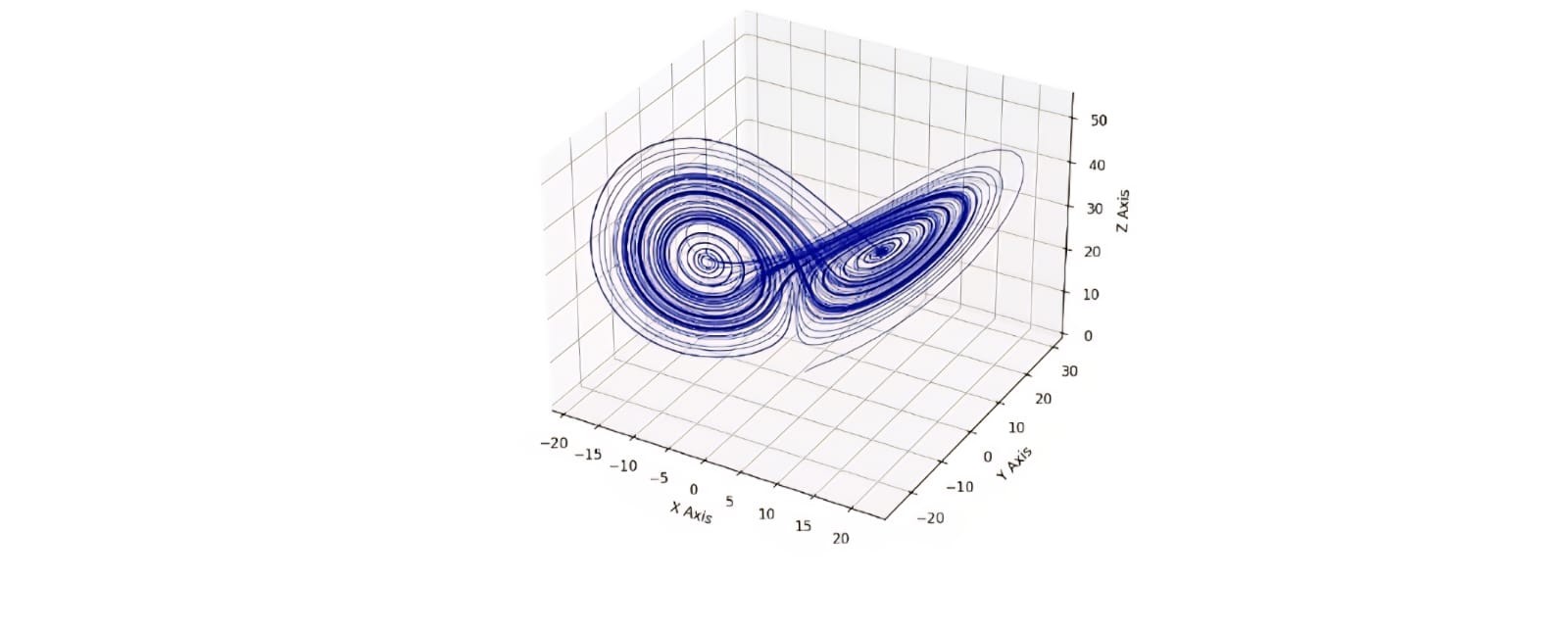
The following python code produces the Lorenz Attractor, which is a classic example of the butterfly effect. The governing set of differential equations are given by

$$ \frac{dx}{dt} = \sigma(y-x) $$

$$ \frac{dy}{dt} = x(\rho - z) - y $$

$$ \frac{dz}{dt} = xy - \beta z $$

The code and the outcome obtained is given below

 1
 2
 3
 4
 5
 6
 7
 8
 9
10
11
12
13
14
15
16
17
18
19
20
21
22
23
24
25
26
27
import numpy as np
import matplotlib.pyplot as plit
from mpl_toolkits.mplot3d import Axes3D
sigma=10.0
rho=28.0
beta=8.0/3.0
dt=0.01
steps=10000
xs=np.empty(steps+1)
ys=np.empty(steps+1)
zs=np.empty(steps+1)
xs[0], ys[0], xs[0] = (0.0,1.0,1.05)
for i in range(steps):
    x=xs[i]
    y=ys[i]
    z=zs[i]
    xs[i+1]=x+sigma*(y-x)*dt
    ys[i+1]=y+(x*(rho-z)-y)*dt
    zs[i+1]=z+(x*y-beta*z)*dt
fig=plit.figure(figsize=(10,7))
ax=fig.add_subplot(111,projection='3d')
ax.plot(xs,ys,zs,lw=0.5,color="darkblue")
ax.set_title("Lorenz Attractor (Butterfly Effect)",fontsize=14)
ax.set_xlabel("X Axis")
ax.set_ylabel("Y Axis")
ax.set_zlabel("Z Axis")
plit.show()

Lorenz Attractor